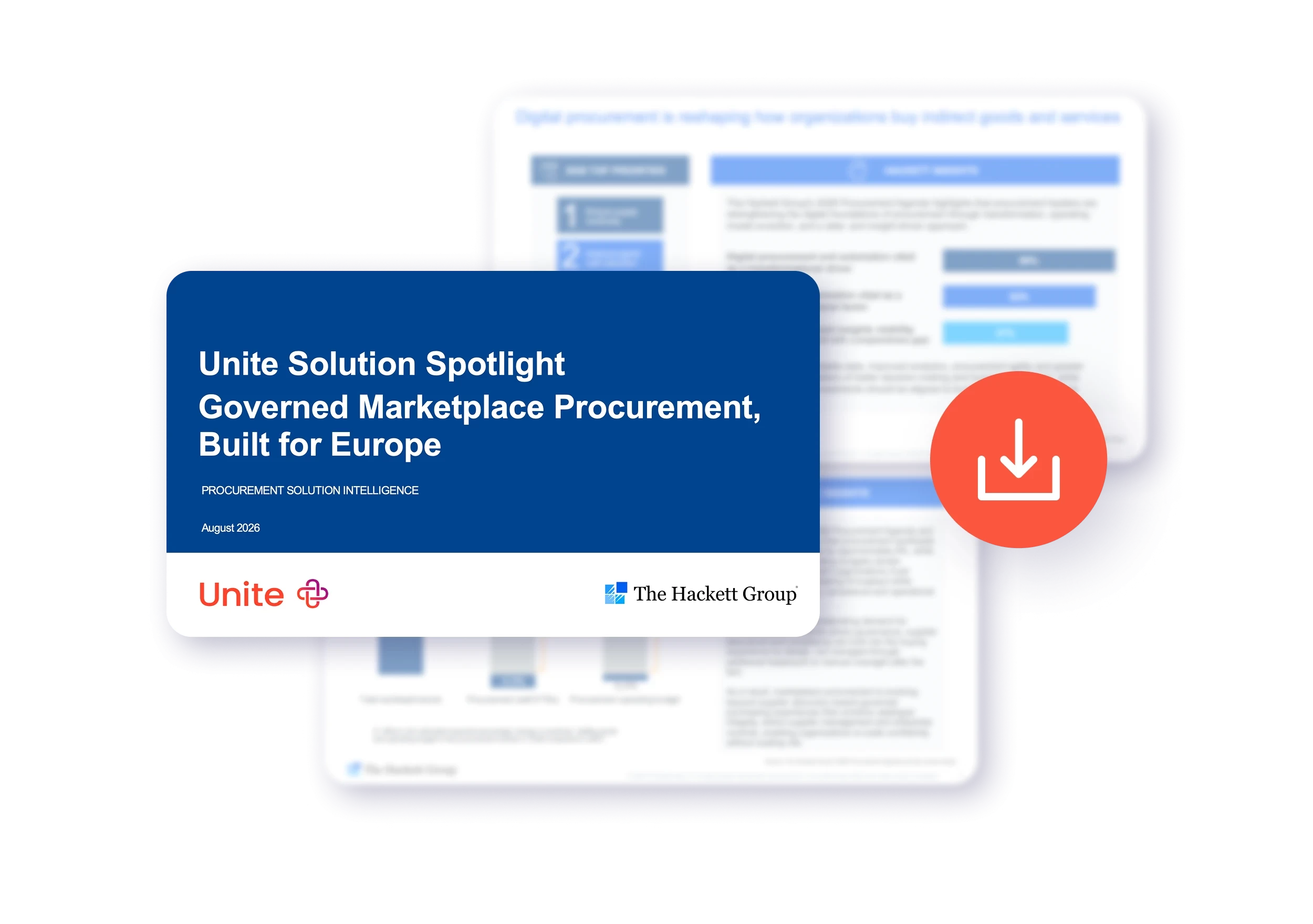

Read the full report
The foundation most teams miss before automating procurement
Most organisations are responding to rising procurement workloads by reaching for more automation and AI tools.
Hackett's research flags a related concern: 37% of procurement leaders cited deep, real-time data and insight visibility as a critical trend – a real preparedness gap.
Automation built on inconsistent product data, duplicate suppliers, or an ungoverned catalogue doesn't remove the risk; it compounds it at scale.
Hackett's report makes the case for starting somewhere more foundational: a governed catalogue. Clean, well-classified product and supplier data is what makes purchasing decisions trustworthy in the first place.
8.0%
Expected growth in procurement workload for 2026
-0.9%
Expected change in procurement staffing for 2026
-0.4%
Expected change in procurement budget for 2026
Only 37%
of procurement leaders cite in-depth data and visibility as critical
The next generation of marketplace procurement isn’t about offering more suppliers — it’s about helping organisations buy smarter while maintaining governance, compliance and control.
Xavier Olivera Solution Intelligence Analyst, The Hackett Group
What you’ll learn
- Why catalogue quality matters: as purchasing volume outpaces headcount, poor data makes automation scale bad decisions faster.
- What catalogue governance looks like: product classification, catalogue validation, and supplier data quality controls ensure consistency at the point of purchase.
- How it fits your existing stack: a governed catalogue and marketplace complements — rather than replaces — your ERP and source-to-pay systems.

About Unite
Unite is a European procurement platform combining a single-creditor marketplace with governed catalogue intelligence and expert services – transparent by design and free from conflicts of interest. It makes indirect procurement compliant, efficient and resilient, reducing operational load while maintaining cost control.
About The Hackett Group
The Hackett Group is a global strategy and operations consulting firm, known for its benchmarking research and best-practice studies across procurement, finance, and other business functions. Its Solution Spotlight series gives independent analyst perspective on the technology and process approaches shaping how organizations operate, including this report on governed marketplace procurement, developed with Unite.
Key takeaways
Procurement workloads are projected to grow ~8% in 2026, while procurement headcount and operating budgets stay essentially flat (The Hackett Group, 2026).
Only 37% of procurement leaders say they're prepared for the deep, real-time data and insight visibility they rate as a critical priority.
Automating on top of an ungoverned catalogue — inconsistent product data, duplicate suppliers — doesn't reduce risk; it accelerates it.
A governed catalogue means consistent product classification, validated supplier data, and quality controls applied at the point of entry.
This is an independent Hackett Group Solution Spotlight developed with Unite, covering why catalogue governance is a prerequisite for procurement automation to succeed.
FAQ
A governed catalogue is a product and supplier data set that's been consistently classified, validated, and quality-checked — so every item is comparable, accurate, and trustworthy at the point of purchase, rather than inconsistent or duplicated across systems.
Automation runs on the data underneath it. If a catalogue has inconsistent product data, duplicate suppliers, or ungoverned entries, automation doesn't fix those problems — it executes on them faster, turning small data issues into larger, faster-moving risks.
The Hackett Group's 2026 Procurement Agenda and Key Issues Study found that 37% of procurement leaders cited deep, real-time data and insight visibility as a critical trend — an area they flagged as a preparedness gap — even as workloads are projected to grow roughly 8% in 2026 with flat headcount and budget.
Unite is a governed marketplace procurement platform that combines catalogue governance, supplier enablement, and procurement intelligence within a single operating model — without replacing an organization's existing ERP or procurement systems.
