
Key takeaways: Procurement automation and catalogue governance
Procurement teams are under more pressure than ever to do more with the same headcount and budget, and the natural response is to automate procurement wherever possible: more tools, more AI, more automation. But The Hackett Group's 2026 research shows the real bottleneck isn't a lack of automation – it's the underlying data foundation. Only 37% of procurement leaders cite deep, real-time data and insight visibility as a critical trend, and Hackett flags this as a preparedness gap. Automating on top of an ungoverned catalogue with inconsistent product data, duplicate suppliers, and unclear categories doesn't remove that risk. It just lets you make the same mistakes faster. Before you automate procurement, the question worth asking is simpler and less exciting: is your catalogue data actually clean?
More work, unchanged budget and headcount – the pressure behind the procurement automation rush
Procurement workloads are growing year by year, but headcount and budget are not. According to The Hackett Group's 2026 Procurement Agenda and Key Issues Study, procurement teams are facing roughly 8% more work in 2026, while headcount and operating budgets remainessentially flat.
Faced with that challenge, most teams reach for the seemingly obvious solution: more procurement automation. More procurement tools. More AI added to existing workflows, to do the work people and budget can't keep up with.
Automation is an important step. But it’s not the first one.
What most teams overlook before they automate procurement
The research flagged another noteworthy finding: only 37% of procurement leaders cited deep, real-time data and insight visibility as a critical trend.
That's a strikingly low number for something automation depends on so heavily. And it's exactly the gap Hackett points out: most teams simply aren't prioritising the data foundation enough.
Why does that matter so much? Because automation runs on data.
If you feed a set of procurement tools an inconsistent catalogue – duplicate suppliers, product data that means three different things in three different systems – not even the smartest automation will fix it. It'll just execute on it, faster than a person ever could. A mistake that used to take a while to make now happens instantly, and at scale.
So, before the question "which AI tool should we deploy next," there's a more practical one teams need to ask: is the data underneath it actually good enough to trust?
Before you add more AI procurement tools, fix your catalogue
There’s a widening gap between how fast organisations automate and how well-governed the data they feed it actually is.
This is not an abstract "data quality" problem, but something that will eventually unavoidably show up in everyday moments:
Two sourcing teams comparing products that aren't really the same product, so a sourcing decision is built on comparisons that were never truly comparable.
A supplier's compliance status that's technically on file, but months out of date – the compliance failure waiting to happen.
Categories that become fragmented – is it "office chairs" or "ergonomic seating"? – taking your spend visibility down with them.
None of that gets fixed by adding another point solution. The only way to fix these issues is by governing the catalogue underneath everything else: consistent product classification, validated supplier data, quality controls applied at the point of entry rather than cleaned up after the fact.

The best-performing teams take care of governance first, automation second
As Xavier Olivera, Solution Intelligence Analyst at The Hackett Group, puts it:
"The next generation of marketplace procurement isn't about offering more suppliers – it's about helping organisations buy smarter while maintaining governance, compliance and control."
That's the shift Hackett is pointing to getting governance right is what makes everything built on top of it actually work.
None of this is an argument against automating procurement, or against AI and procurement tools generally. It's simply about the sequence: what comes first for automation to work.
Get the catalogue governed first, and automation becomes something you can trust. If you skip that step, automation just becomes a faster way to be wrong.
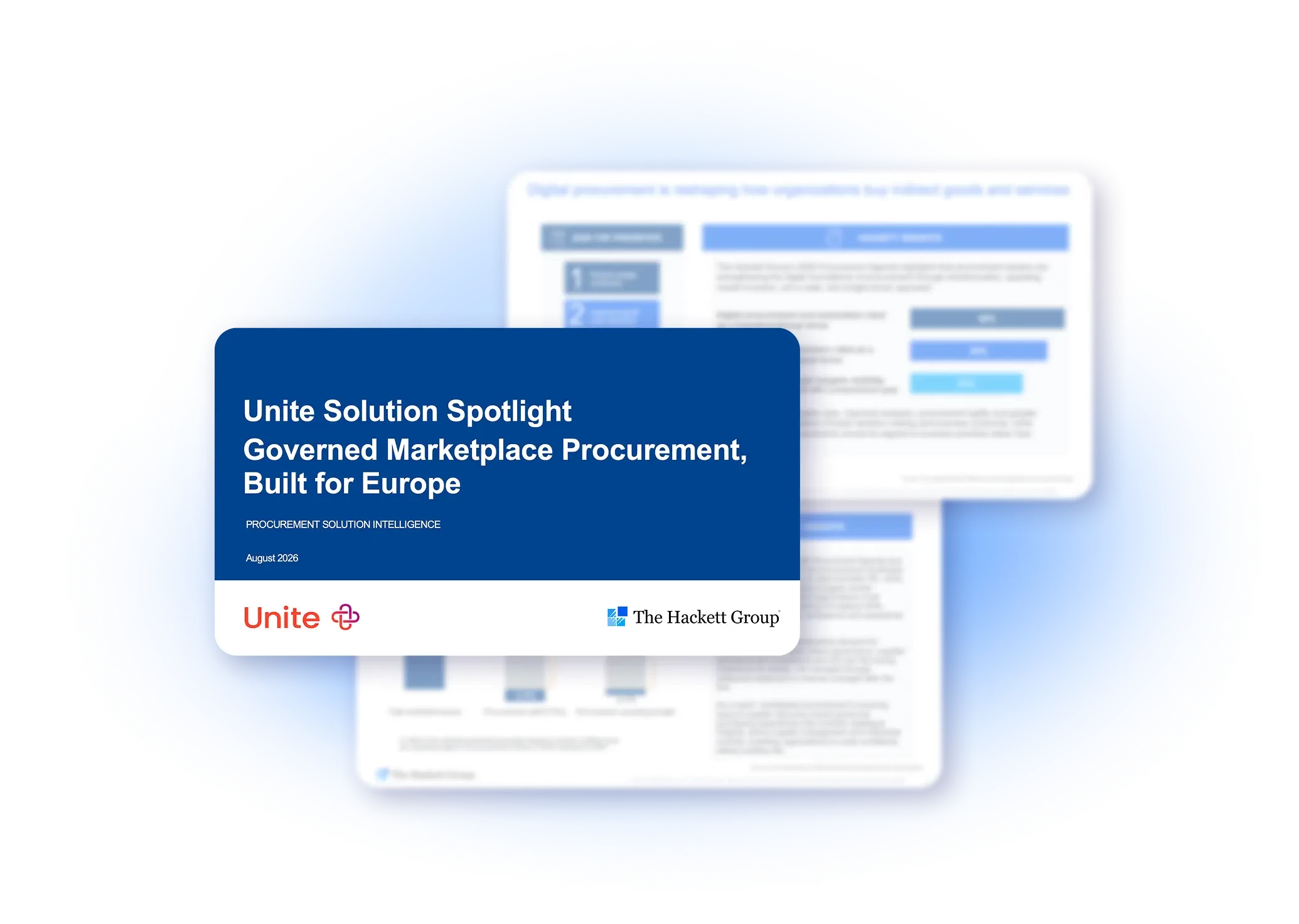
The Hackett Group's Solution Spotlight on Unite goes into this in more depth – an independent analyst's take on why governance, not just more suppliers or more automation, is becoming the real differentiator in procurement, and what that looks like in practice for organisations trying to scale without scaling risk.
Frequently Asked Questions
According to The Hackett Group's 2026 Procurement Agenda and Key Issues Study, procurement workloads are projected to grow roughly 8% in 2026, while procurement headcount and operating budgets stay essentially flat.
Only 37% of procurement leaders rate deep, real-time data and insight visibility as a critical trend – a strikingly low number given how much automation depends on it.
Automation runs on the data underneath it. Feeding it an inconsistent catalogue with duplicate suppliers, product data that means different things in different systems, doesn't remove those problems. It just executes on them faster.
Consistent product classification, validated supplier data, and quality controls applied at the point of entry rather than cleaned up after the fact.
No. The point isn't to avoid automation. It's about sequence. Getting the catalogue governed first is what makes automation something a team can actually trust.
As Xavier Olivera, Solution Intelligence Analyst at The Hackett Group, puts it: "The next generation of marketplace procurement isn't about offering more suppliers — it's about helping organisations buy smarter while maintaining governance, compliance and control."