What is indirect procurement?
Indirect procurement is the process of sourcing the goods and services a business needs to operate – everything from office supplies and facilities services to IT equipment. Indirect spend is often high in volume and highly fragmented, spread across many categories, suppliers, and departments, which makes it harder to manage centrally compared to direct spend. For many organisations, indirect spend now accounts for a large share of total procurement volume, and its inconsistent management leads to cost, efficiency, and compliance risks.
Indirect vs. direct procurement
The core difference between indirect vs. direct procurement comes down to what the purchase is for: direct procurement covers the materials and components that become part of a company’s finished product, while indirect procurement covers everything that keeps the business running but doesn’t go into the product itself, from office supplies to professional services.
That difference also shapes how each is managed. Direct procurement is usually centralised, forecasted precisely for production schedules, and closely tied to supplier relationships built for consistency and volume. Indirect procurement, tends to be more fragmented across different departments. It’s harder to forecast, and often lower on the priority list, even though its volume and complexity often rivals direct spend.
What's changing for indirect procurement in 2026–2027
Indirect procurement's workload has been increasing for years, but 2 things are converging to make 2026–2027 a real turning point: budgets and headcount are staying flat while spend, supplier count, and compliance requirements keep growing, and the definition of success has shifted alongside it.
Cost saving is no longer the primary goal – what matters more today is scaling without adding headcount and cutting manual work. Getting there takes both a clear strategy and the right use of AI: not AI for its own sake, but AI applied with purpose, inside a well-governed process.
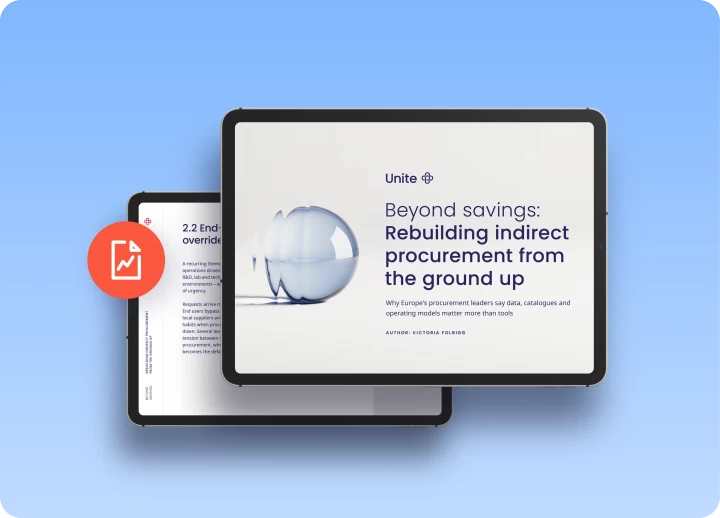
Our Expert Report 2026, ‘Beyond savings: Rebuilding indirect procurement from the ground up’ shows:
5,618 hours
of annual process effort per indirect procurement team.
250 suppliers
managed per team, alongside thousands of P2P transactions.
20% additional workload
from ESG reporting alone. Without extra headcount.
Want the full picture?
See how procurement leaders across Europe are tackling these exact challenges.
Building an indirect procurement strategy
A strong indirect procurement strategy isn’t just about controlling cost, but also about giving a fragmented, high-volume spend area the same structure, visibility, and intentionality that direct procurement usually gets. That starts with a few core disciplines working together.
Strategic procurement
Strategic procurement sets the direction for how an organisation sources, buys, and manages supplier relationships – aligning day-to-day purchasing decisions with broader business goals like cost control, risk management, and supply resilience, rather than treating each purchase as an isolated transaction.
Category management
Category management groups related spend – such as IT equipment, facilities, or marketing services – into defined categories, each managed with its own sourcing approach, supplier relationships, and performance benchmarks. This lets procurement teams apply focused expertise and negotiating leverage within a category, rather than managing every purchase the same way regardless of what's being bought.
Procurement management
Procurement management covers the operational discipline of running the procurement function itself – policies, approval workflows, supplier governance, and performance tracking – ensuring that strategy actually translates into consistent, controlled buying behaviour day to day.
How the indirect procurement process works
Once a strategy is in place, it needs a process to run through – the systems and steps that take a purchase from an identified need to a completed transaction.
E-Procurement
E-procurement refers to the use of digital platforms to manage purchasing – from searching and comparing products to submitting requests and processing orders – replacing manual, paper-based, or email-driven buying with a structured, trackable digital process.
Procurement process
The procurement process is the step-by-step journey a purchase follows: identifying a need, sourcing options, requesting approval, placing the order, and completing payment. A clearly defined process is what makes a procurement strategy operational. Without it, even a well-designed strategy breaks down into inconsistent, ad hoc buying.
Source-to-Pay / S2P
Source-to-pay describes the full, end-to-end procurement cycle – from sourcing and supplier selection, through purchasing, all the way to invoicing and payment – as a single connected process rather than a set of disconnected steps handled in separate systems.
Procure-to-Pay / P2P
Procure-to-pay covers the latter half of that cycle specifically: from the moment a purchase is requested through to the final payment being processed. It's often the part of the process most visible to day-to-day buyers, since it includes requisitioning, approval, ordering, receiving, and invoice matching.
Common challenges — and how Unite resolves them
Superficial catalogue data
Most catalogue data is organised at a basic level – enough to search by keyword or manufacturer, but not enough to compare products on functionality. That makes it hard to define requirements independently of a specific brand, or to prove a fair, functional comparison was made.
Unite classifies products in detailed, functional categories, so requirements can be defined by function, not brand, which is mandatory above certain thresholds under public procurement law. It also supports deeper analysis of ordering behaviour, beyond standard eClass categories, to help teams identify core requirements for tenders.
Fragmented tools and lost visibility
When indirect spend data lives across different tools and catalogues, procurement teams lose the full picture – and often manage multiple separate systems just to complete a single purchase. Every switch costs time, and every handoff is a chance for a new error: a purchase made outside policy, a price that was never compared, spend nobody can fully see.
Unite brings spend, supplier, and purchasing data together in one connected platform, with full transparency across core, supplementary, and tail spend categories. Instead of piecing information together from multiple systems, teams get a single, reliable view of what they are buying, from whom, and at what cost, inside one governed process.
Maverick buying
Maverick buying – purchases made outside agreed processes and suppliers – happens when the sanctioned process is harder or slower to use than working around it. It's rarely about bad intent; it's almost always about friction.
Unite reduces that friction by keeping buying inside one connected system, with clear policy controls built in – for example, spend thresholds that automatically route a purchase to a manager for approval once it crosses a defined limit. When the right process is also the easiest one, maverick spend naturally drops significantly.
Constantly changing legal requirements
Compliance requirements for procurement are getting more specific, particularly in the public sector – with growing regulation across ESG, sustainability, data protection, and sanctions compliance across multiple countries.
As a European platform, Unite is built with this regulatory reality in mind, helping procurement teams stay ahead of changing requirements rather than reacting to them after the fact.
Limited time for strategic thinking
Day-to-day transactional purchasing leaves little room for real strategy. Chasing approvals, fixing errors, and manually processing orders takes up the time procurement teams need for anything else, including thinking about how AI could reshape the process.
Unite automates routine purchasing across core, supplementary, and tail spend, leaving teams more time for what only they can do: sourcing strategy, supplier relationships, category management, and building a well-planned approach to using AI.
Team overload
Procurement workloads are growing faster than procurement teams are. Without a clear strategy, overload compounds – more manual work, more reactive firefighting, less time for anything strategic.
Unite addresses this at the source: one platform instead of several, AI-supported processes that reduce manual effort, and a system built to scale with the business without requiring the team to scale at the same rate.
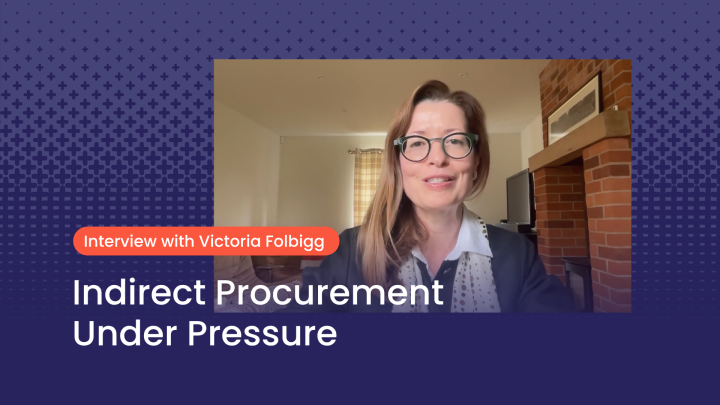
Indirect procurement isn't broken. It's overloaded.
– an expert interview on what's really driving the pressure procurement teams are under right now.
The quiet crisis in indirect procurement – and the scalable PraaS solution you're missing
– new research on what's driving the workload crisis, and how a more scalable operating model can help.
The risk of not having a well-planned indirect procurement strategy
Supply chain risk
Fragmented supplier relationships and limited visibility make it harder to spot disruption coming; a supplier's financial trouble, a single-source dependency, a region facing new instability. Without oversight, procurement often finds out about these risks at the same time as everyone else, when there's no longer time to act ahead of them.
Legal and compliance risk
Regulatory requirements around ESG reporting, data protection, and sanctions compliance are expanding quickly and becoming more specific. Without a system that tracks these requirements centrally, compliance becomes a manual, after-the-fact fix rather than something built into how purchasing already works.
Maverick spend and policy erosion
When procurement processes are inconsistent or hard to follow, buyers work around them – and every workaround chips away at negotiated pricing, preferred supplier agreements, and the audit trail the organisation needs when questions get asked later.
Cost and margin risk
Beyond wasted budget, a weak strategy means missed volume discounts, duplicated spend across departments, and a slower ability to react when input costs shift – the kind of losses that rarely show up as a single number, but compound quietly over a fiscal year.
AI in procurement: huge potential, but real risks
Where AI has the biggest impact
AI has real, practical potential to improve indirect procurement, particularly for larger organisations managing multiple locations or business units, where manual processes struggle to keep pace. Used correctly, AI makes it easier for buyers to find what they actually need, cutting down time spent searching and comparing.
Use AI with intent, not as a shortcut
AI only helps when it's used with intent. That means giving the right people the right access, and keeping AI-supported buying aligned with a company's existing purchasing policy – not operating around it. AI should make procurement's own process easier to follow, not create a shortcut around it.
AI that works within your company policy
Demand for AI-powered intake and orchestration is growing as procurement teams seek to manage more requests without adding more manual work. AI can understand a request, ask the right follow-up questions, classify it and route it to the appropriate workflow, system or expert. This helps procurement respond faster while applying policies consistently and keeping the right level of human oversight.
Why Unite's AI actually works
One reason why several partners chose to work with Unite is that it starts a step earlier: catalogue and supplier data are organised and enriched at the source, so whatever is built on top of it – search, recommendations, conversational tools – has something reliable to work from.
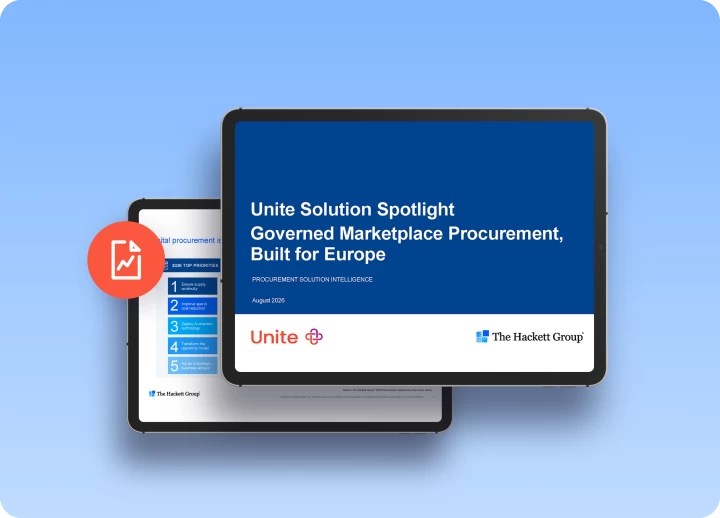
The must-have before automating indirect procurement
An independent Hackett Group report on why clean, well-governed catalogue data – not more automation – is what lets indirect procurement teams actually scale, without adding headcount.
Frequently Asked Questions
Indirect spend covers things like office supplies, IT hardware and software, travel, facilities management, marketing services, and professional services such as consulting or legal support. These purchases don’t become part of the company’s products or services, but they keep the business running.
In many companies, indirect spend often rivals or even exceeds the direct procurement spend – even though it typically receives far less strategic attention and centralised control.
Indirect procurement is usually managed by a procurement or purchasing team, but in practice, ordering happens across many departments – IT, marketing, facilities, and more – which is part of why it's harder to control centrally than direct spend.
Yes. Unite covers core, supplementary, and tail spend in indirect procurement. Products are organised across roughly 35,000 categories, from broad groupings down to detailed subcategories. That level of depth applies across spend areas, so buyers can search and compare within a category as specifically as they need to, rather than working with a handful of broad labels.
Yes. Unite keeps buying inside a single platform with policy controls built in – for example, spend thresholds that automatically route a purchase to a manager for approval once it crosses a defined limit – making it easier to stay within policy than to work around it.
Yes. Teams can source through Unite's marketplace and host their own negotiated framework catalogues within the same platform.
Yes. Unite gives full transparency across pricing, supplier information, and ESG data in one connected platform, rather than spreading that information across separate systems.
Not necessarily. Unite connects to most of the systems teams already use, so there's no need to abandon existing tools to start working from a single platform.
Unite includes benchmarking and expert consulting alongside the platform itself, so teams get support in acting on their procurement data, not just access to it.
Yes. As a European platform, Unite is built with the region's regulatory environment in mind, including growing requirements around ESG reporting, data protection, electronic invoicing, and sanctions compliance.