
The technology is ready. Procurement, in most companies, is not yet.
What do you fix first? What may an agent do? Who answers for it? And how do you know it’s working? Here is how I would decide.
DPW Amsterdam is very good at showing the art of the possible. It has never been easier to buy a procurement solution, and it has never been harder to tell solutions apart. We have gone from best of suite to best of breed and now to AI-native, and the choice keeps widening.
The technology is ready before we are. My instinct is that the hardest procurement problem for the next twelve months is the operating model. Technology choices follow from it, and few organisations have worked it out yet.
The five decisions below are my synthesis of the conversations at DPW and the follow-up chats after the event. They are the questions I would want answered as a CPO before letting an agent anywhere near a buying decision.
Where I’m coming from: I spent seven years as a CPO, I wrote Unite's 2026 Expert Report on indirect procurement, and I am now CEO of CASME, where earlier this year I co-facilitated a member panel on the practical use of AI in procurement. I draw on all three.
1. If you could recode one part of procurement before introducing AI, what would it be?
My first answer: slow down before going in headfirst. That sounds odd when everyone is telling you to move faster, so let me be precise. Slow down on commitment, but never slow down on learning.
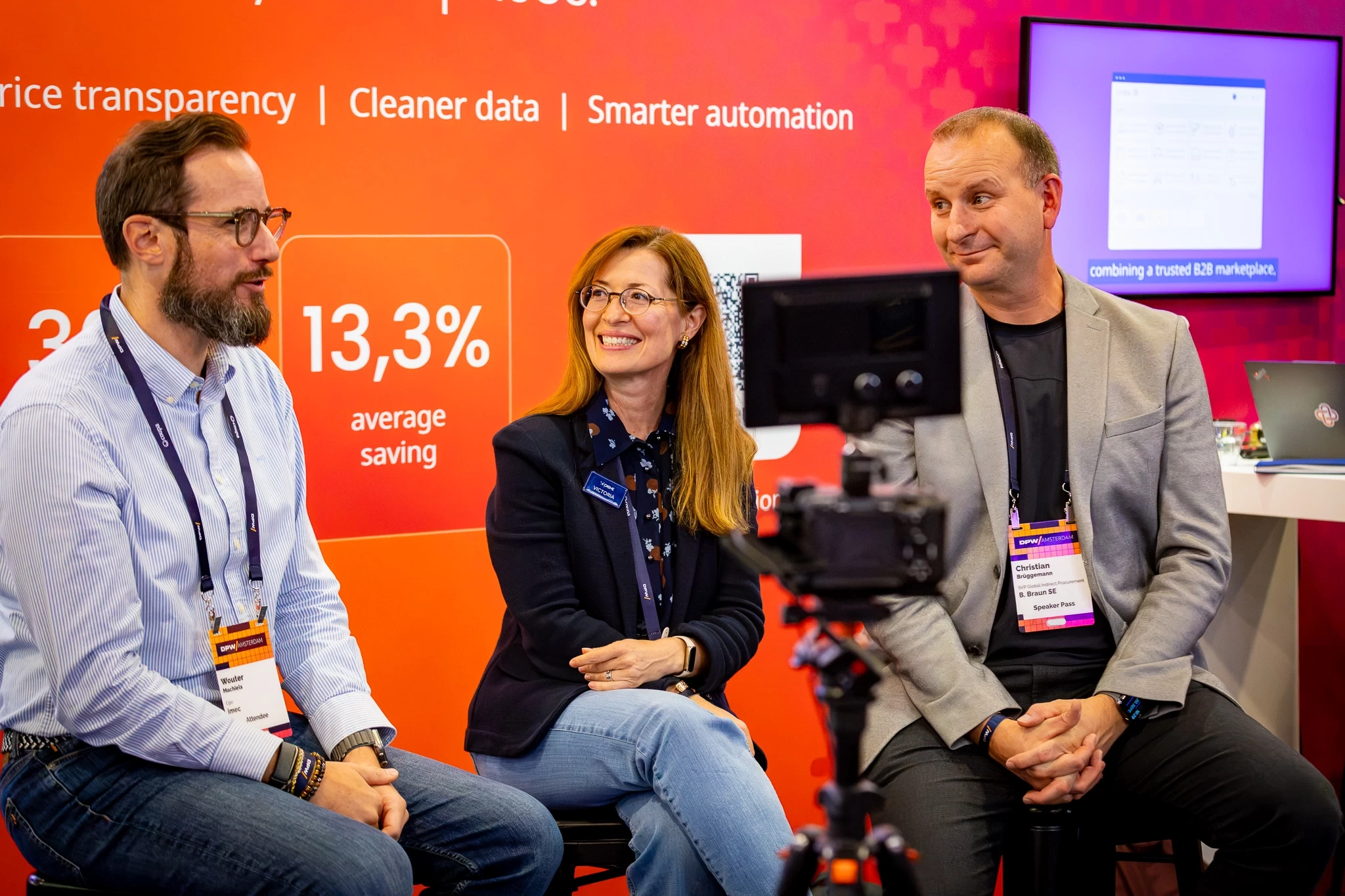
Christian Brüggemann, SVP Global Indirect Procurement at B. Braun, gave me the counterpoint in our panel talk at DPW. In med tech, he said, speed is one of the most critical parameters. It is how you get ahead of the competition. B. Braun also pilots heavily in controlled environments before any agent goes live. This shows that fast learning and careful commitment can sit together.
CASME’s own data points the same way. Our panel event in March 2026 captured it well: you are not behind if AI is not yet scaled across your function. You are behind if your team is not actively testing and building capability. In the poll involving around 100 practitioners, two thirds of procurement leaders had adopted AI in some activities. None had adopted it across all of them.
So, strip it back to what you need now and why. Parag Parekh, Chief Digital Officer at Ingka Group (IKEA), put it well in a McKinsey interview this year: “The discipline of prioritization is as important as the ideas themselves.”
Then pick one real buying journey and walk it. Skip the abstract AI-readiness assessment. Look at where the data comes from, which suppliers sit in it, where the decisions are made and what you measure today. In my experience the constraint shows itself within a week.
At DPW, I picked up a few interesting stories, listening to presentations and speaking to procurement leaders. Two stuck with me:
A US-headquartered digital company had a travel and expenses policy that nobody seemed to use, and one procurement person supporting it for the whole US location. The policy was fine. The constraint was capacity and adoption. They built a chatbot to help employees with the policy and tested it for a month with a small team from procurement and IT. Once it gave the right answer 80% of the time, they opened it to the wider company. Every few months, they reviewed it: what it answered correctly, and what it had to hand to a person. As the hand-offs fell, the expansion question came up. Stay in the US and give it more authority, so it books travel itself? Or keep it as an adviser and roll it out to the UK office? Deepen or widen. That is exactly the kind of decision checkpoints are for.
Another one: a European gas grid operator started with one narrow job: placing transport orders against framework agreements it already had. Each order used to take half a working day. It now takes 15 minutes. Nothing company-wide, no new contracts, no waiting for perfect data everywhere. One journey, contracts already in place, and a clear return. Half a working day per order was a process problem that looked like a technology one.
To decide what goes first, I use a CASME framework that weighs how easy a use case is to embed against its strategic impact. Then I ask one more question: How much authority does it need? An agent that classifies spend recommends. An agent that buys commits money. Start where authority is low and learning is high.
That is why I think analytics is procurement’s secret weapon. Spend analysis came top of CASME’s practitioner poll on AI value at 77%, yet too few demos at DPW showed what AI-powered analytics can now do. Procurement could build the most insightful data engine in the company, combining internal and external data to run forecasts and simulations nobody else can.
Starting small is fine. A modest agent working on one country’s data, with a clear purpose and a measurable return, is a perfectly good start. It does not need to be company-wide to be worth doing.
Be realistic about the data timeline. During our panel talk at DPW, Brüggemann mentioned that it took B. Braun two years to clean, enrich, map and translate their data for the AI era. “There is no shortcut… plan ahead.” Any use case that depends on data you have not started fixing goes to the back of the queue.
The data an agent acts on must be reliable on the day it acts. The data around it, such as classification, enrichment and supplier attributes, can improve during a controlled pilot. An agent acts on its own only when the error rate is below a threshold you set in advance and someone owns the data.
First step: choose one buying journey where the data is largely sound, but manual handling or unclear approvals create friction, and walk it end to end.
2. What must an AI agent be able to trust before it recommends a purchase or takes action?
In the 2026 Expert Report, I wrote that a marketplace amplifies the quality of what goes into it, but it does not and cannot fix underlying weaknesses. An agent does the same, only faster and at scale.
I see three types of suppliers emerging around procurement data.
The experience layer
Very nice, shiny, and it makes it easier for stakeholders to buy. But it isn't deep.
Data originators
They hold the detail: SKU-level data, delivery performance, ESG, quality and risk credentials. Many of them are small suppliers.
Data refiners
They make sense of the data for your organisation. External AI cannot clean your data to your needs on its own, because it doesn't know your policies, your organisation or how you code things. You either build it yourself or bring talent in.
Agents can act inside and on top of all three. For me, the bottom two matter the most. Here’s why:
The originators. If the origin isn't clear, complete and accurate, everything built on top is lipstick on a pig, however touchless it looks. My report for Unite found supplier digital immaturity to be a hidden but critical constraint. Many SMEs still struggle to provide structured, accurate catalogue data, and procurement ends up as the manual buffer.
Ownership matters as much as quality. Brüggemann also explained: “If you have data that's not owned by anybody, nobody will trust it because there is no owner. And if you have data you don't trust, imagine the AI agent takes over and gives you a decision which is untrusted.”
The refiners. Wouter Machiels, CPO at imec summed it up: “AI cannot fix a data dump that is unstructured and unclear”. Once the basics are fixed, you can “tell your agents where they can intervene and where they can't.”
So, walk one indirect purchase from search to order. Where would a wrong article, an out-of-date price or an ineligible supplier be caught today? Those are the points where an agent must stop, ask, or hand over to a person. Before granting any authority to act, test the recommendations against four measures: findability, contracted-channel adoption, price exceptions and supplier-data completeness.
Then add two measures that show the recommendations are safe: the rate of wrong items or ineligible suppliers caught before an order is placed, and how often the agent escalates to a person when it should.
The catalogue governance basics from my report still apply: standard attributes, controlled updates, supplier accountability for data quality and first-time-right KPIs.
First step: name the owner of the supplier information and the item data for your chosen journey. If nobody owns it, fix that before anything else.
3. Who is accountable when an agent recommends, negotiates or places an order?
I think of authority as a dial with four settings:
The agent suggests a buying route.
It drafts the requisition.
It negotiates within boundaries you have approved.
It commits spend.
For each setting, name the owner, the approval threshold and the audit trail. Most organisations should sit at the first two settings for a while, and that is fine.
Brüggemann was clear in our panel talk: “Accountability still sits with the human, and it's connected to decision-making.” Machiels named three things that stay human: supplier relationships; the grey areas between yes and no, judging whether a flagged risk is acceptable against the commercial need; and, most importantly, the vision and strategy for procurement, which “is not something you can outsource to an agent.”
AI can analyse complex data at speed and surface insight. The judgement, the power to make the decision and the conviction to lead with it stay with people. And in my opinion, they should.
My caution is over-engineering. It is tempting to build a complex map of every possible option and scenario, so the agent always knows what to do. That underplays the reality and complexity of some procurement and commercial situations and undermines and then removes the necessary human judgement. Home in on the handful of decisions that must stay human, design clean hand-offs around them, and let the rest learn.
Learning has limits. Only a named owner can change the rules, every change is logged, and a person reviews the agent's decisions on a set rhythm, monthly to start.
Procurement earns its seat in AI strategy by owning these controls. Supplier approval, spending and negotiation limits, exceptions, disputed outcomes: this is already our territory. If AI decisions are being made without procurement, owning the controls is the practical way back to the table.
First step: write down which setting the agent sits at, and who signs off the move to the next one for your chosen journey.
4. What should change in how you choose procurement AI tools?
AI is moving too fast for traditional supplier selection and implementation models. By the time a twelve-month RFP and implementation cycle lands, the capability you chose a supplier for has been overtaken.
I'll be controversial. The technology is a commodity now. By technology, I mean the AI capability itself. Today, you can build a procurement intake model yourself on a general-purpose AI tool such as Claude. Everyone has access, and the engineering and technology moat is nearly gone.
So, what are the differentiators?
The team building it for you.
The company's direction, history and values.
How it is funded. Some suppliers are profitable and build to keep customers for the long term. Others are VC-backed and may build to win customers fast and then exit. Two different models for two different CPO needs. Know which one you are buying from, and which one you need.
That is why the team matters: they decide what gets built next and who turns up when it breaks. Direction, history and values tell you whether they will still be building for you in five years. Beyond funding, test commitment with references from customers who have been with them for two years or more, an open roadmap conversation, and exit terms that tell you how your data comes back.
Then ask every vendor one more question: where does the transactional base data come from? In the CASME poll, 26% of leaders flagged vendors exaggerating their AI capabilities as a top challenge. A proof of concept on your own data is the most reliable test.
Now lift the lid on information and data security, because the nuance matters. Classify your data sets first. Not everything needs SOC 2 or ISO 27001 certification, but the core system holding your supplier, contract, transaction, or employee data must. Data security and privacy topped the CASME challenge poll at 51%.
For a small agent on non-sensitive local data, ask for data processing terms and a commitment not to train on your data. For anything touching core systems, add ISO 27001 certification or a SOC 2 Type II report. Where personal or contract data is involved, add the sub-processor list and where processing happens. Your security team sets the final bar.
On European data sovereignty, hosting data in the EU on its own does not make a tool sovereign or compliant. Before data enters an AI workflow, I would want five answers:
Where is it stored and processed?
Who can access it, including sub-processors?
Is it used to train models?
How long is it kept?
How do you get it back out?
First step: classify the data your first use case will touch. Set the security bar for that data, not for the whole programme.
5. How do you turn a promising AI pilot into a working procurement model?
Normalise failure and build it in. A pilot that cannot fail is a demo. Before you start, know your go/no-go criteria and your progression gates: what moves a use case from test to scale, and what makes you stop, redesign or expand.
Run a bounded 90-day test. Set a baseline and pick two or three outcomes: time to find and buy, share of spend through compliant channels, exception rate, cost to serve per purchase order.
Name an owner accountable for value beyond go-live before the pilot launches. CASME panellists described the pattern too well: excitement drives deployment, the project team moves on, usage drops.
Procurement is no different from any other technology adoption story. In the end it comes down to how much change people can absorb next to their day job. As Parekh says in his McKinsey interview, “a capability is only as good as its deployment and adoption.”
Leave time for the right people to experiment. Start with your most mature users, who show you what good looks like. Widen to the cautious middle, who surface the edge cases. Do not let the least ready group set the pace.
Another story from DPW shows what earned expansion looks like. A global carmaker's logistics procurement team started with one category in one region. Leadership made adoption a formal goal: every buyer ran one or two sourcing events on the new platform within six months. Only then did they add the next categories, and they now plan to expand region by region. Average sourcing event time fell by more than half. One category, one region, a clear adoption bar, a planned review window, a look at what worked and what didn't, adjustments, and only then expansion at each stage.
Scaling is an operating-model question. Decide which demand goes to a catalogue or contract, which to sourcing and which to a person. Then check whether processes, skills, incentives and governance support that split. The Hackett Group's Spotlight Report on Unite expects procurement workloads to rise a further 8% this year with flat budgets and headcount. A pilot that adds work without taking any away will not survive that.
I am a big fan of a lot of IKEA’s thinking, and Parekh is refreshingly honest about it. He admits that years of cost cutting have already reduced the quality of some back-office services and sees AI as a way to win that quality back. That is a stark insight for anyone who puts FTE reduction at the top of their AI business case.
First step: write the ‘stop, redesign, or expand’ criteria for your pilot before it starts.
The decision that comes next
Pick one buying journey, where information is largely in place, but unclear approvals or manual steps cause friction. Set a baseline. Decide who decides and who checks the exceptions. Test the smallest workflow you can trust. Scale only if the buying outcome improves.
The tools will keep changing. The operating model underneath them is where the work is, and it is procurement's to design.
Ready to recode indirect procurement?
Book a consultation with Unite to walk through your processes, see where you're held back, and what a governed marketplace could change.
Frequently Asked Questions
Start with one real buying journey. Check where its data comes from, which suppliers sit in it, where decisions are made and what you measure today. The constraint usually shows itself within a week.
No. The data an agent acts on must be reliable on the day it acts, with a named owner. The data around it, such as classification and enrichment, can improve during a controlled pilot. Any use case that depends on data you have not started fixing goes to the back of the queue.
A person. Think of authority as a dial with four settings: the agent suggests a route, drafts the requisition, negotiates within approved boundaries, or commits spend. For each setting, name the owner, the approval threshold and the audit trail. Most organisations should stay at the first two settings for a while.
Treat the AI capability itself as a commodity and compare what differs: the team building it, the company’s direction, history and values, and how it is funded. Ask where the transactional base data comes from, run a proof of concept on your own data, and set the security bar for the data your first use case touches.
Run a bounded 90-day test with a baseline and two or three outcomes. Set go/no-go criteria and progression gates in advance, and name an owner accountable for value after go-live. Start with your most mature users, then widen to the cautious middle.