Key takeaways
AI talk was everywhere at DPW Amsterdam this year. The theme was RECODE, and across two days of talks, panels, and booth conversations, one point kept coming back from different people in different sessions: AI only delivers value when the foundation underneath it is ready. Clean data, governed catalogues, vetted suppliers, and clear governance determine what AI can do for a procurement team. Here is what we heard.
The question everyone asked at the booth
The question most of our conversations started with was: "What AI features does Unite have?"
It's a natural place to begin, and from here, the conversations only went deeper. We discussed what must be in place before any AI feature can be trusted: clean data, a governed catalogue, vetted suppliers. AI features are also becoming a commodity. Nearly everyone has access to them now, and on its own AI is an interface and an automation layer, not more. What is harder to get right is everything underneath it.
Benedikt Wieser, Co-Lead of Unite's Transformation Taskforce, draws a clear line between technology and a solution. Multi-supplier sourcing, market mechanisms and harmonising supplier data are very procurement-specific problems, and they need a solution that understands procurement deeply.
Technology gives us an ability to solve problems, but it is not an end in itself.
– Benedikt Wieser, Co-Lead of Unite's Transformation Taskforce
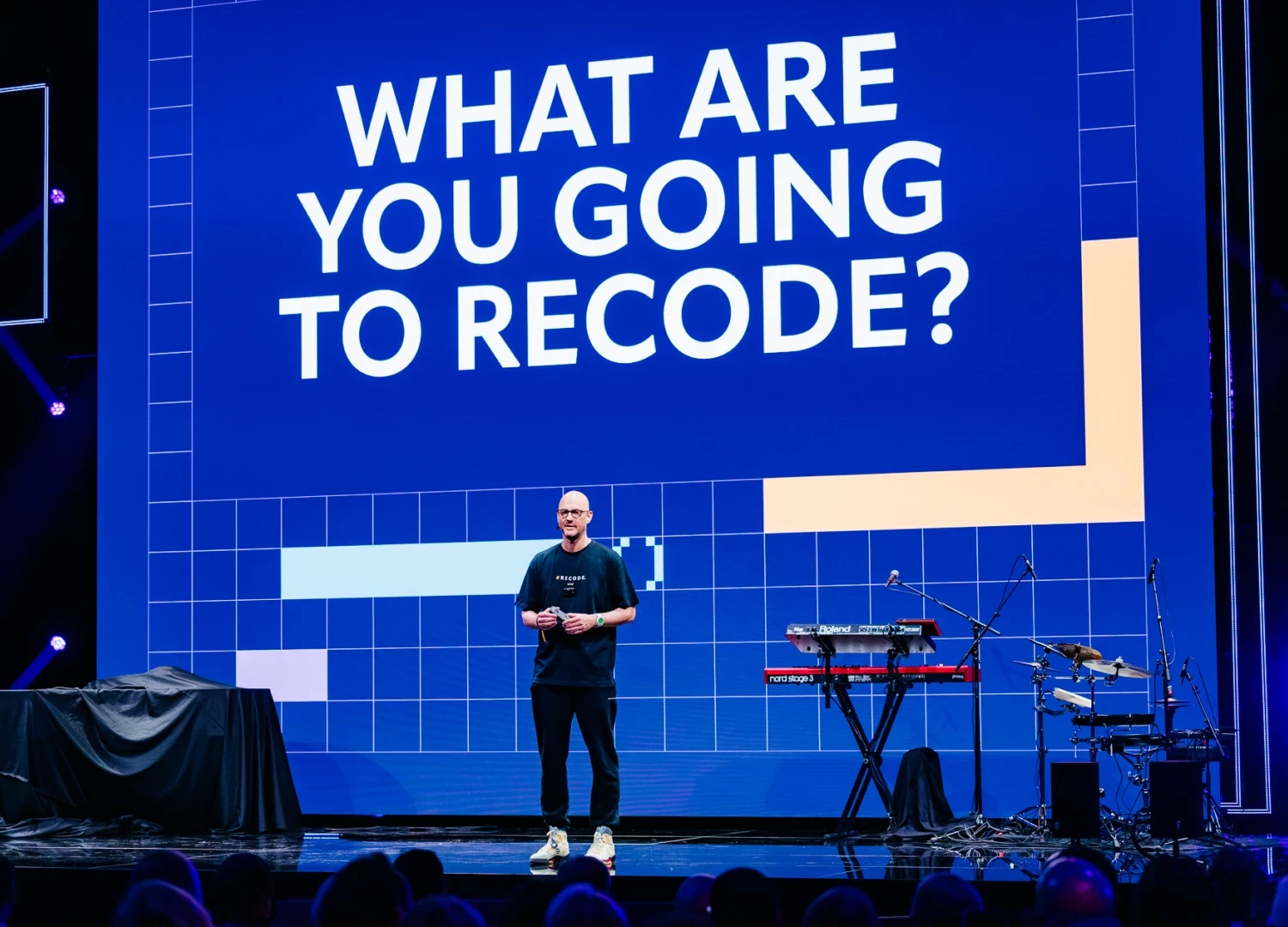
That's also why RECODE felt like the right theme for this year. DPW put it plainly on their own site: "AI is everywhere. Real progress isn't. The next decade won't be won by adding more tools, but by rethinking how procurement and supply chain operate: how work is structured, how decisions are made, and how humans and machines work together at scale."
We couldn’t agree more. Procurement teams need a proper look at what's underneath before another tool or AI feature goes on top. One session even put numbers on it.
Fewer than 1 in 10 organisations are AI-ready
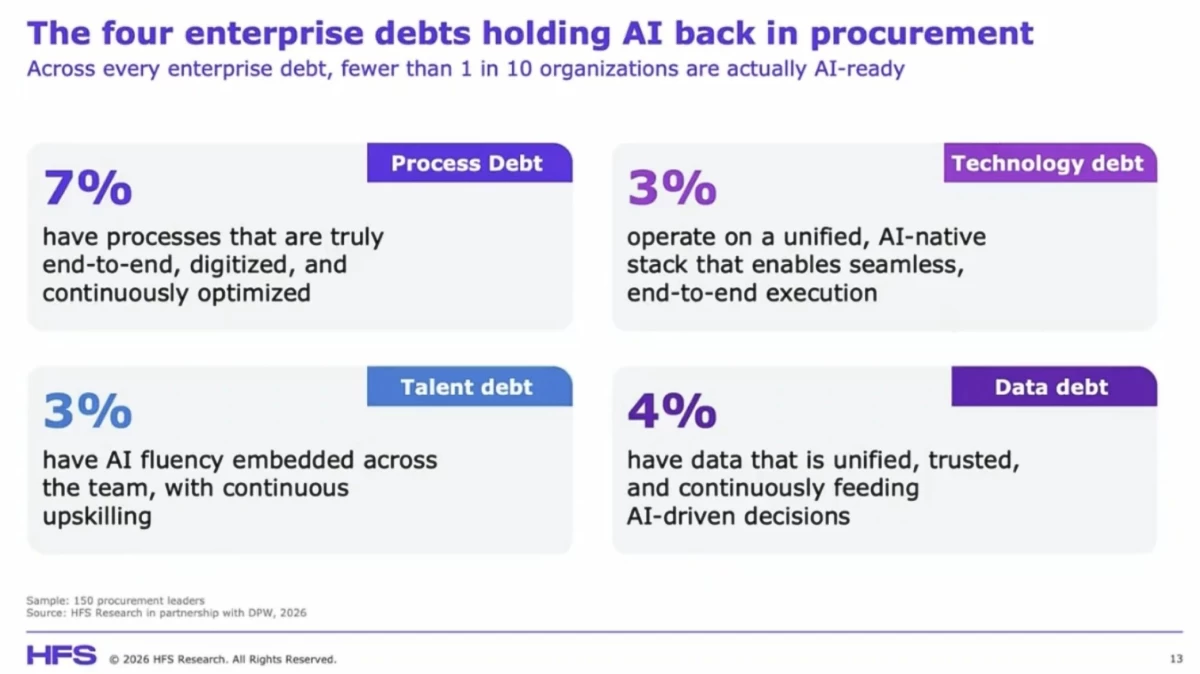
Saurabh Gupta, President of HFS Research, presented new insights based on a survey of 150 procurement leaders, titled "AI Is Ready. Procurement Is Not."
HFS looked at four areas it calls enterprise debts. In every one of them, fewer than 1 in 10 organisations are AI-ready:
Process: only 7% have processes that are truly end-to-end, digitised and continuously optimised
Technology: 3% operate on a unified, AI-native stack
Talent: 3% have AI fluency embedded across the team
Data: 4% have data that is unified, trusted and continuously feeding AI-driven decisions
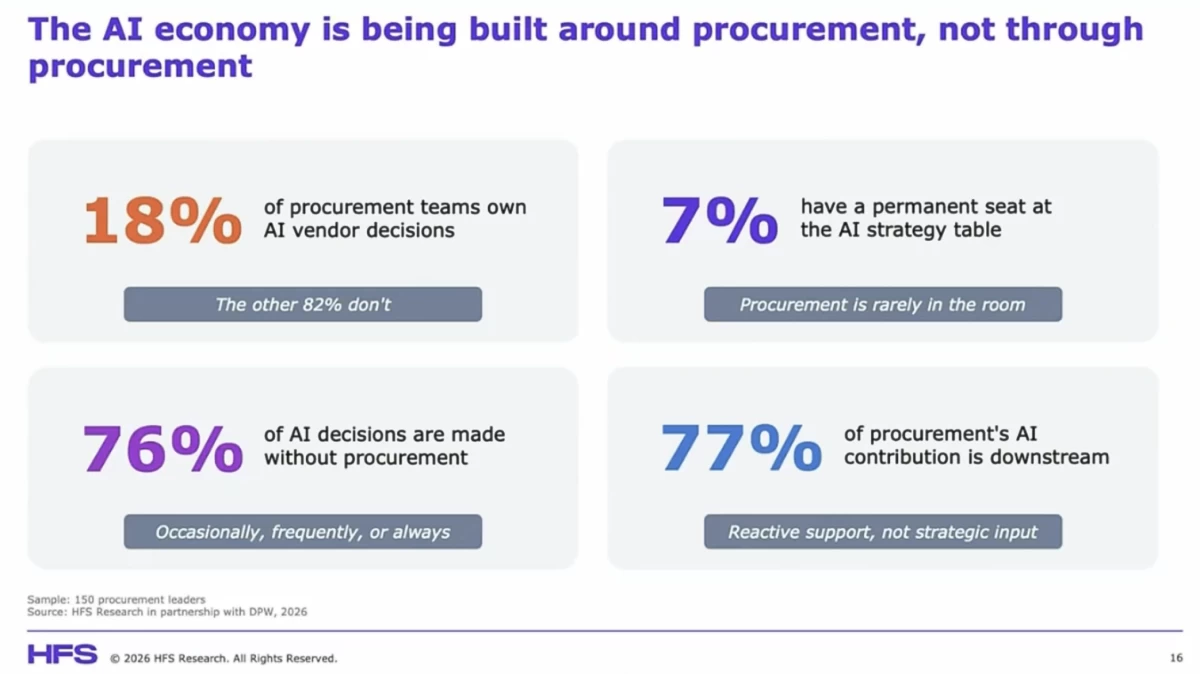
The same research looked at who makes the calls. Only 18% of procurement teams own their AI vendor decisions, just 7% have a permanent seat at the table where AI strategy gets set, and 76% of AI decisions are made without procurement teams. As Gupta put it on stage: the AI economy is being built around procurement, not through it.
That also points to an opportunity. The things AI depends on most – trusted supplier data, governed catalogues, compliant buying channels – are in procurement's territory. Teams that get those foundations right have a practical route to the table, because they control what every AI tool needs to work.
When nobody can see their own prices
In our work with indirect procurement leaders, a pattern comes up again and again: framework agreements and supplier catalogues are not as managed as they would need to be. It is common for a company to work with 2,000 distinct indirect suppliers, and the cost of simply managing that many relationships leaves most teams with no room to look closely at individual prices.
If you ask a head of indirect procurement whether they know their prices across a 30,000-article catalogue, the honest answer is usually the same: they don't have a chance. Nobody can track pricing manually at that scale.
Prices are only half of it. Pascal van Neer from Unite sees the same silos from the user's side:
Many organisations struggle with catalogue silos. They have numerous framework agreements, but users often can’t find what they need, and there is no search function across the different sources. Procurement, on the other hand, doesn’t get the volume in their contracts.
– Pascal van Neer, Senior Account Executive, Benelux
When users can't find the agreed item, they buy elsewhere. Spend leaks out of the contracts procurement negotiated, volume drops, and the data any AI has to work with has more gaps. The easier it is to find what you need, the more spend stays on the agreed channels, and an AI layer added on top of unmanaged catalogues inherits the same blind spots.
European data sovereignty is no longer a small detail
Another topic came up in many of our conversations: How can European procurement teams keep up with evolving data and compliance regulations?
For a long time, data sovereignty wasn't at the top of a compliance checklist. That's changing. With EU regulation tightening and many AI tools still built on infrastructure outside Europe, procurement leaders agreed that this has become a real factor in deciding who they are willing to trust with their data.
The pressure doesn't go away once you have picked a vendor. It shapes every AI tool, every supplier relationship and every piece of data a procurement team touches from here on. That makes it part of the foundation, and a separate compliance topic only on paper: if you can't say where your data sits and who can reach it, you can't build AI on top of it with any confidence.
From hype to operating model
The range of companies at DPW told its own story. On one end, AI-native startups showed what procurement could look like if you built it from scratch today. On the other, companies with decades or centuries of history talked about how they had absorbed one technology shift after another without stopping the business.
The message we heard repeatedly was simple: AI can change a great deal, but the foundation underneath it matters more than the hype. Around that foundation, leaders consistently mentioned:
simpler technology,
clear processes,
people with the right skills, and
a realistic route from ambition to something that works in the long run.
Nataša Vidmar of AstraZeneca gave a talk titled "Firm Foundations: From AI Hype to Functioning Reality", which put it especially well: more value, more speed, more resilience, more sustainability. Now add AI. That "now add AI" is the hard part, because a vendor's vision only becomes useful once someone works out where it fits, what it replaces, what it depends on, and which business outcome it is meant to move. That translation layer, which turns technology vision into something that runs inside a real operating model and delivers a measurable result, is the part teams need to pay attention to right now.
Procurement is not one uniform flow: different types of demand call for different sourcing mechanisms and different channels, and those channels shift with the market, the category and the risk. A setup that can't adapt as that happens becomes a liability, not a shortcut. AI can help steer demand towards the right channel, but only when the data and suppliers behind each channel can be trusted.
The question is no longer just what AI could do for procurement. It’s how to make it work in established businesses, building on trusted data, clear processes, and the experience of teams that know how to evolve while keeping the business running.
– Olga Inozemtceva, Head of Go-to-Market at Unite
The real question after DPW
The question worth asking after DPW is who has the foundation to turn AI into measurable value. Tools will keep changing. Whether AI adoption works comes down to the people running it and the foundation it runs on, a partner chosen for how well it fits your organisation, and governance built in from the start, well before anything scales past the pilot stage.
RECODE was the right word for this year, because it names what many organisations still have to do: take a proper look at what sits underneath before stacking another tool on top. That is where the real work is, and it's what we spend most of our own time on – we've got more to share on that soon.
More to come in CPO Strategy Magazine
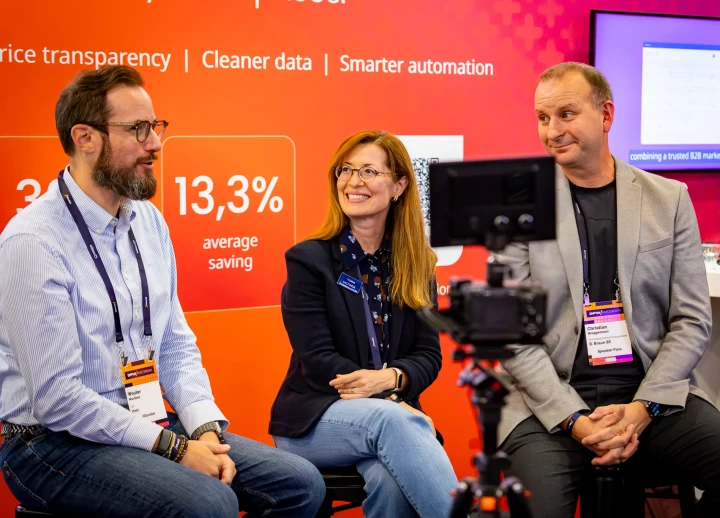
One conversation we're especially looking forward to sharing is a panel interview with Victoria Folbigg, former CPO and author of Unite's 2026 Expert Report, Christian Brüggemann, Senior Vice President Global Indirect Procurement at B. Braun, and Wouter Machiels, CPO at Imec. It will be featured in CPO Strategy Magazine's November issue, alongside further insights from the procurement leaders we spoke with at the event. Keep an eye out for it next month.