About this webinar
Let’s face what the evidence shows. Indirect procurement keeps hitting the same walls – not because of a lack of tools, but because the underlying foundations aren’t in place: inconsistent data, fragmented governance, and suppliers who struggle to deliver reliable, structured catalogue content. Meanwhile, ESG workload keeps expanding.
That’s the central thesis behind the new Expert Report, ‘Beyond savings: rebuilding indirect procurement from the ground up’, by Victoria Folbigg – an ex-CPO with nearly 30 years’ experience in global procurement. It combines two layers of evidence:
A quantitative Unite–HTWK study with 181 European procurement professionals (2025)
Qualitative validation through interviews with 7 European procurement executives (2026)
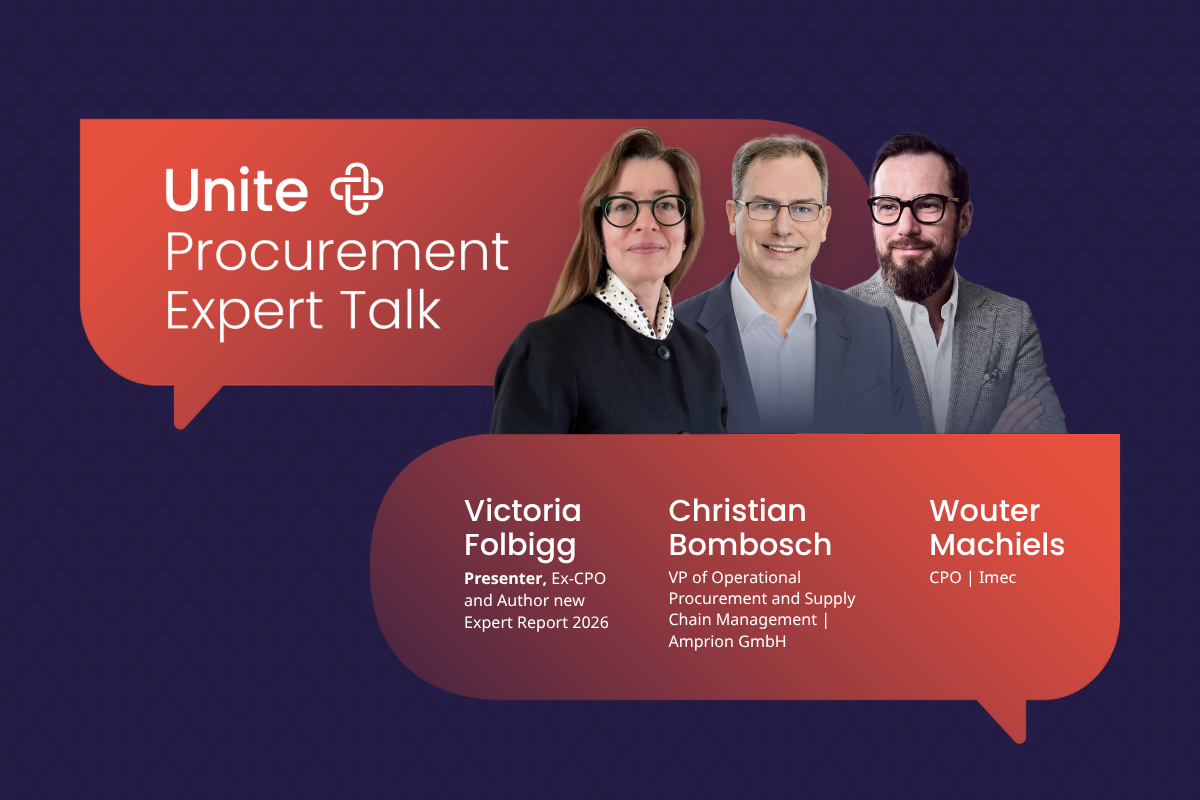
In this Expert Talk, Victoria is joined by Christian Bombosch, Vice President Operational Procurement and Supply Chain Management at Amprion, Germany, and Wouter Machiels, CPO at imec, Belgium. Together, they discuss the five root causes behind procurement overload – and what rebuilding a resilient operating model looks like in practice.
What you’ll take away
Clarity on the five root causes that keep indirect procurement stuck – and why digitalisation alone won’t fix them.
Best practice insights on how procurement leaders are rebuilding their operating model.
A free calculator to quantify your process cost – and build your CFO business case in minutes.

Can’t make it live?
No problem. We’ll send you the recording afterwards.
Experts
Wouter Machiels
CPO Imec – Nederlands/Belgium
Wouter leads the procurement function in an environment shaped by urgency, availability expectations and high standards for data quality and supplier enablement.
His work centres on rebuilding the operating model so indirect purchasing stays controllable – even when demand is unpredictable and ESG requirements must be built into day‑to‑day buying.

Victoria Folbigg
Presenter and author of Expert Report ‘Beyond savings: rebuilding indirect procurement from the ground’
Founder and CEO of Folbigg Consulting (UK), Victoria is a procurement leader, adviser and educator with 30 years of global experience. A former CPO, she works at the intersection of procurement, technology and strategy, and has launched an AI education initiative focused on practical, responsible adoption to improve decision-making and outcomes.
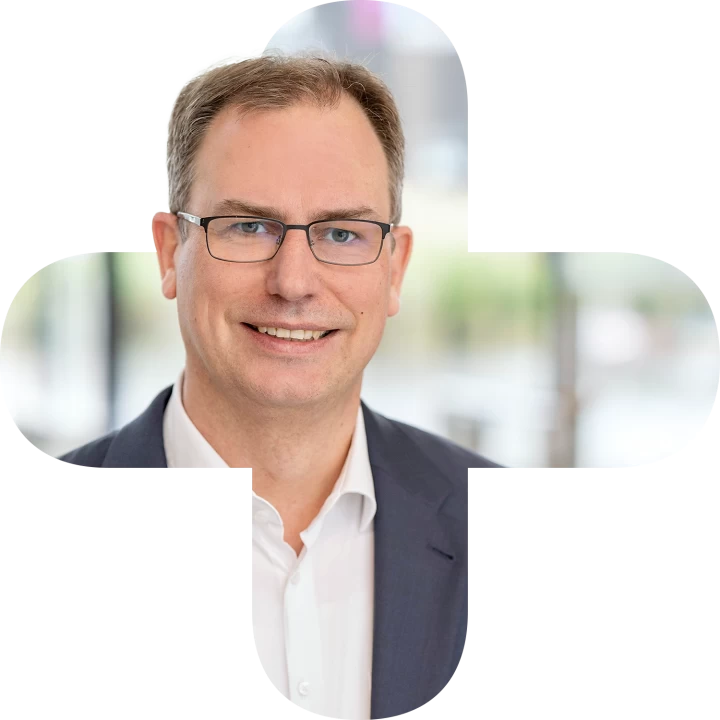
Christian Bombosch
Vice President of Operational Procurement and Supply Chain management, Amprion GmbH.
Chtristian leads operational procurement across major infrastructure programmes, where indirect materials and supplier performance directly impact delivery and results.
He focuses on rebuilding procurement capabilities for a more reliable operating model, including the foundations that make buying faster, more transparent and easier to govern.
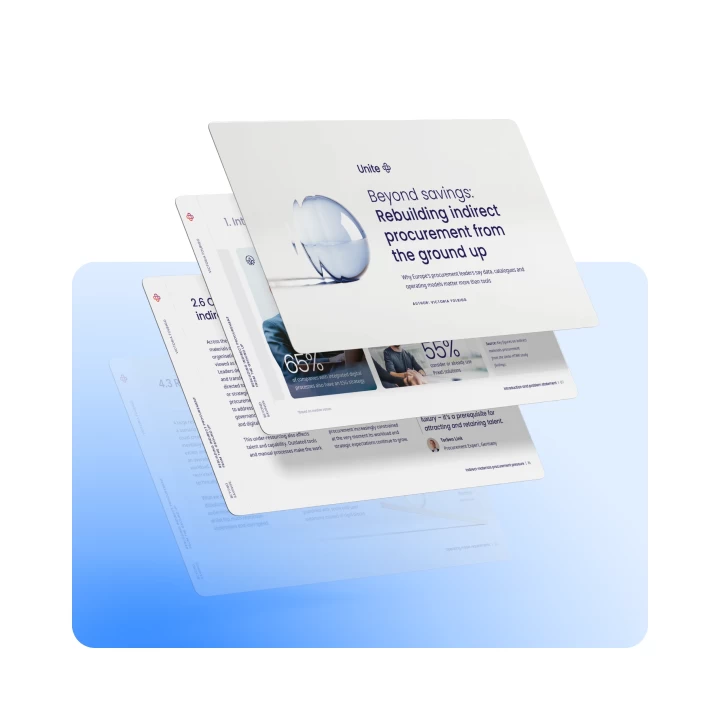
About the new Expert Report 2026
The report ‘Beyond savings: rebuilding indirect procurement from the ground’ by Victoria Folbigg identifies five structural root causes behind the growing pressure on indirect procurement. These root causes reinforce one another in a domino effect that no single tool, system or savings initiative can break.
The analysis begins with the Unite–HTWK Study, a quantitative study carried out by Unite and the Leipzig University of Applied Sciences, surveying 181 procurement organisations across Europe. The findings reveal the real workload of indirect procurement teams and show how process effort increases as responsibilities expand – without a corresponding rise in capacity. To complement the data, the report includes interviews with 7 senior indirect procurement leaders from Germany, the Netherlands, Italy and Sweden, spanning manufacturing, automotive, energy, semiconductors and telecommunications. Their insights confirm what the numbers indicate.
Why should procurement leaders – and also CFOs and CIOs – read this report?
Because it uncovers:
- Where the real EBITDA lever lies beyond ‘savings per order’.
- Where the most hidden barrier to digitalisation emerges.
- How five root causes reinforce each other in a cycle that erodes credibility.
- Why ESG challenges represent a capacity crisis rather than a strategy debate.
- How weak data foundations hinder automation and increase compliance risk.
