UK government spends over £380 billion a year on public contracts, around a third of all public spending. How that money is governed, evidenced and directed toward social value now sits at the centre of the procurement leader's mandate. This article examines what value for money means under the Procurement Act 2023, where public bodies are exposed, and how leading teams are responding: tail-spend control, SME participation, sustainability evidence and audit-readiness.
The rules have changed the definition of value
The Procurement Act 2023 came into force on 24 February 2025, replacing the Public Contracts Regulations 2015. It is the most significant reform in a generation. Its central shift is from the Most Economically Advantageous Tender to the Most Advantageous Tender, a broadening of what counts as value to include social, economic and environmental outcomes.
The evidence shows behaviour changing. In the first three months, the use of quality criteria in open-procedure lots rose from 48% to 72%. The statutory frame reinforces it: the National Procurement Policy Statement sets the priorities, and HM Treasury's Managing Public Money holds buyers to propriety and value. The definition of value has widened. Procurement's job is now to prove it.
Where public bodies are most exposed
The three most common failures in public-sector indirect procurement are spend invisibility, undefendable maverick buying, and unmet social-value obligations. Each is both a value loss and an audit exposure.
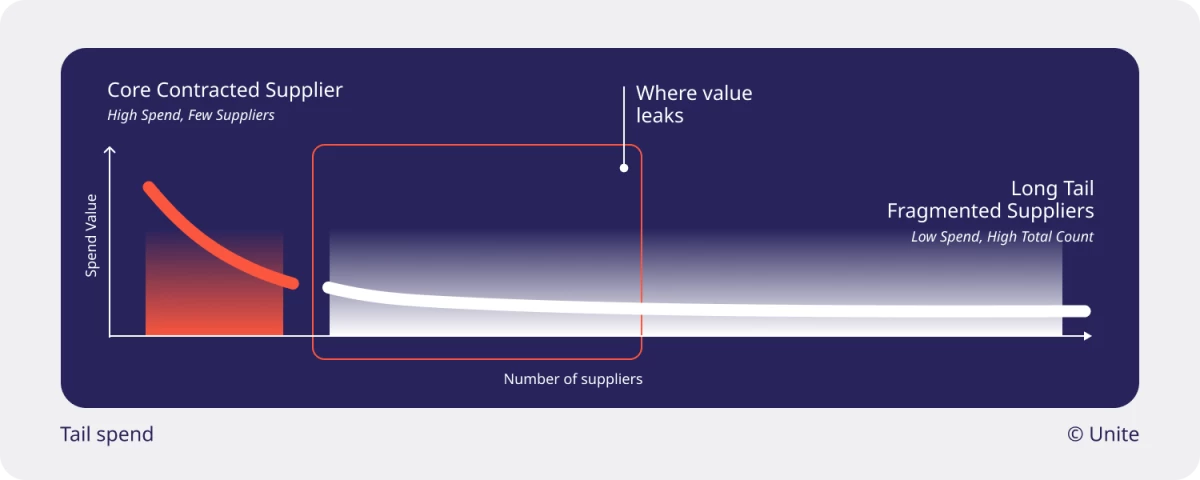
Tail spend is where it concentrates. It can represent up to 20% of total spend but as much as 80% of transactional effort: a small share of value, the majority of the work, and the majority of the supplier count. When urgent purchases bypass approved routes, the resulting spend cannot be evidenced against Contract Procedure Rules, a direct exposure under a regime built on transparency.
The SME participation gap is a measurement problem
UK government wants one pound in every three to reach SMEs. Yet delivering it, and evidencing it, is where most public bodies struggle. Departments cannot direct spend toward SMEs, or prove that they have, without visibility of who they are actually buying from at transaction level.
This is not only a policy problem, it is a measurement one. A governed channel that records SME participation per transaction turns an aspiration into a number, the number the National Procurement Policy Statement cares about most.
Sustainability has become a pass/fail condition
For public buyers, sustainability evidence has moved from bonus to baseline. Every NHS procurement in England already carries a minimum 10% weighting for net zero and social value, and from April 2026 the Evergreen Sustainable Supplier Assessment becomes mandatory for suppliers.
The implication for procurement is concrete: buyers increasingly need line-level environmental evidence, carbon data per order, not basket-level estimates, to clear tenders that a qualitative claim would once have passed.
How leading public procurement teams are responding
Leading public bodies are converting these pressures into a repeatable operating model. Several practices stand out.
First, leading organisations bring tail spend into one governed, framework-backed route, concentrating fragmented buying into a compliant channel where every purchase is visible and evidenced by default. Second, they build the audit trail into the buying flow, purchasing evidence generated as each order is placed, not reconstructed at audit. Third, they treat SME participation as a data discipline, so a policy aspiration becomes a number that can be directed and evidenced. Fourth, they demand line-level sustainability data, and use framework call-off to secure a compliant route without the cost and delay of a fresh tender.
Conclusion
Value for money in public procurement has been redefined. Under the Procurement Act 2023 it means competitive price, directed social value, and audit-ready compliance, proven together, not traded against each other. The public bodies pulling ahead have stopped treating indirect and tail spend as an administrative afterthought and started governing it as the visible, defensible, SME-rich channel the new rules reward. The first move is visibility: you cannot prove, direct or defend spend you cannot see.
Frequently asked questions
Under the Procurement Act 2023, value for money is defined by the Most Advantageous Tender, the best combination of price, quality, social value and sustainability, not the lowest price alone. In practice it means procurement must evidence value across multiple dimensions, and defend every decision under transparency obligations.
Tail spend is where spend invisibility and audit risk concentrate: up to 20% of spend but as much as 80% of transactional effort. When buying bypasses approved routes it cannot be evidenced against Contract Procedure Rules. Bringing tail spend into one governed route restores visibility and makes every purchase defensible.
By treating SME participation as a data discipline. Government targets one pound in every three with SMEs; transaction-level visibility of supplier type is what lets departments direct spend toward SMEs and evidence it for social-value scoring.
Sources: Procurement Act 2023 (legislation.gov.uk) · National Procurement Policy Statement (gov.uk) · NHS England, Evergreen Sustainable Supplier Assessment · Finance Day / House of Commons Library, public-sector tail-spend statistics.