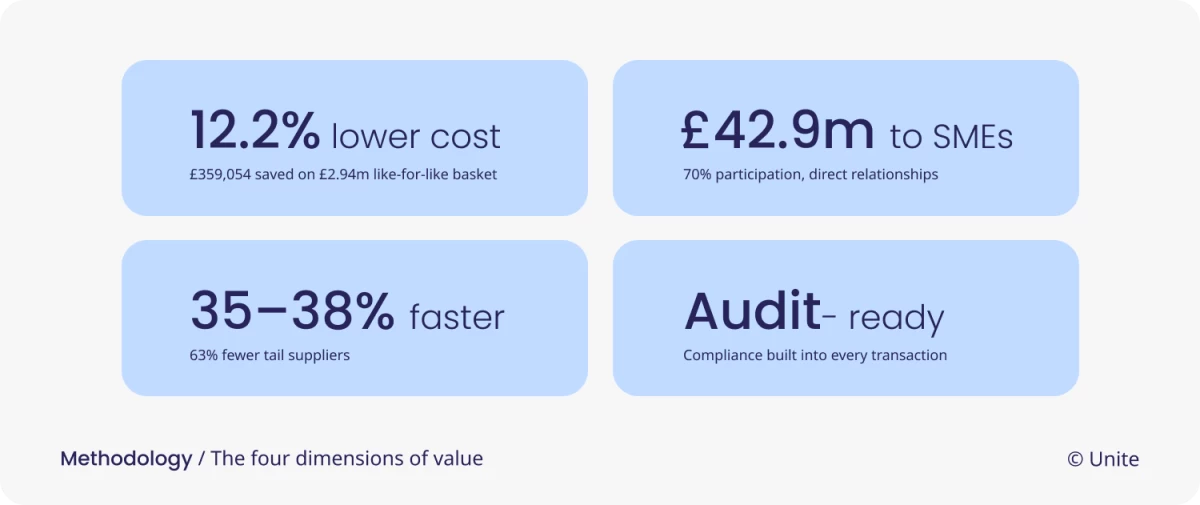
In public procurement, the purchase you cannot evidence is the purchase that fails the audit.
UK government spends over £380 billion a year on public contracts, around a third of all public spending. Under the Procurement Act 2023, in force since 24 February 2025, every pound of it must stand up to a higher standard: award on the Most Advantageous Tender, full transparency, and a trail an auditor can follow.
For most public bodies, the exposure is not the big, competed contract. It is the tail: the high-volume, low-value buying that can reach 80% of transactional effort, and that is almost never audit-ready when scrutiny arrives.
This article examines where the audit exposure sits, why it concentrates in tail spend, and how leading public bodies build the evidence into the buying flow rather than reconstructing it afterwards.
Audit-readiness is a definition problem before it is a data problem
The Procurement Act 2023 replaced the Public Contracts Regulations 2015 and redefined value. Award moved from the Most Economically Advantageous Tender to the Most Advantageous Tender, widening what counts to include social, economic and environmental outcomes.
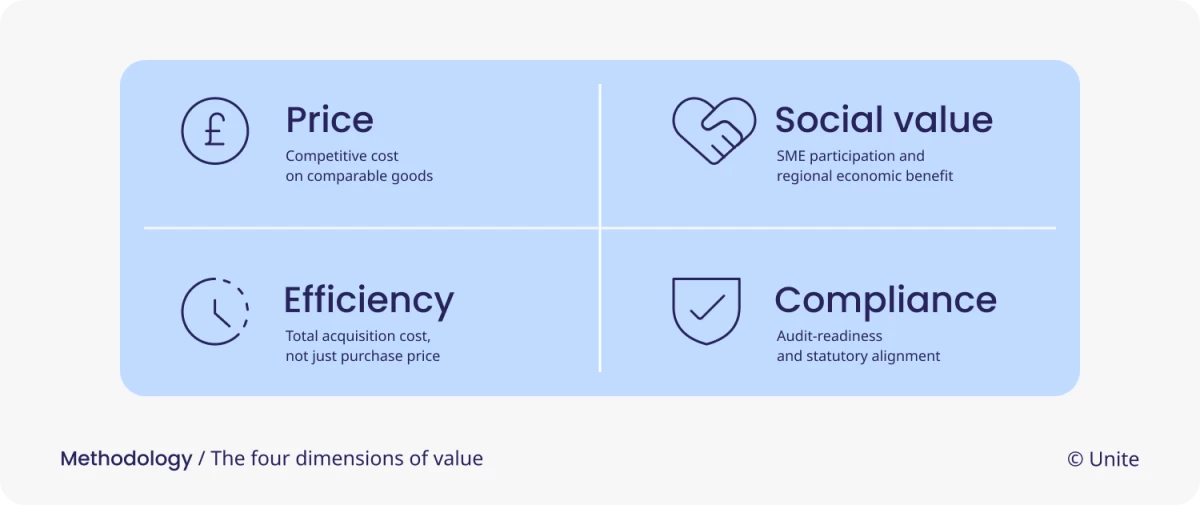
That widening is the point most buyers miss. If value now spans price, social value and sustainability, then defending a decision means evidencing all three, not just the price paid.
The evidence shows the bar has already risen. In the first three months of the Act, the use of quality criteria in open-procedure lots rose from 48% to 72%.
Tail spend is where the audit trail breaks
Tail spend can represent up to 20% of total spend but as much as 80% of transactional effort. It is a small share of value and the overwhelming majority of the work, spread across the largest number of suppliers.
That is exactly where evidence goes missing. When an urgent, low-value purchase bypasses the approved route, there is no record of competitive offers, no justification, and nothing to show a regulator.
Unmanaged spend is ungoverned spend. And ungoverned spend is indefensible the moment the Public Accounts Committee asks.
Reconstructed evidence is not evidence
The common failure is to treat audit as an event: a scramble, weeks after the purchase, to rebuild a trail from invoices and memory. It is slow, incomplete, and it never quite convinces.
Leading public bodies invert this. They generate the evidence at the moment of purchase, a record of competitive offers and a justification captured as the order is placed, so the trail exists before anyone asks for it.
The distinction is simple but decisive: evidence built in is defensible; evidence reconstructed is a best guess.

Navigate the future of public procurement
Access the latest thinking, strategic insights and exclusive downloadable resources to help you navigate the challenges and opportunities shaping public sector procurement.
Social value has to be evidenced, not asserted
The Act made social value a scored, defensible criterion, not a statement of intent. Government wants one pound in every three to reach SMEs, and the National Procurement Policy Statement cares most about direct SME delivery.
You cannot evidence that from an annual report. It requires transaction-level visibility of who you are actually buying from, so participation is a number you can produce on demand.
The honest concession: not every category has a rich SME field, and no platform changes that overnight. But the majority of tail spend can be directed and evidenced, which is where the audit pressure is highest.
How leading public bodies build audit-readiness in
First, leading organisations bring tail spend into one governed, framework-backed route, so every purchase is visible and recorded by default.
Second, they generate purchasing evidence at the point of order, competitive offers and justification captured live, not reconstructed later. Third, they treat SME participation as transaction-level data, so social value is a number, not a narrative.
Fourth, they use framework call-off, such as RM6202, to secure a compliant route without the cost and delay of a fresh tender, so the compliant path is also the fast one.
Conclusion
Audit-readiness in public procurement has been redefined by the Procurement Act 2023. It is no longer a filing exercise; it is the ability to prove value across price, social value and sustainability, on any purchase, at any time.
The public bodies pulling ahead have stopped treating tail spend as an administrative afterthought and started governing it as the place where audit risk concentrates. The first move is visibility: you cannot defend what you cannot see.
Frequently asked questions
Audit-ready means every purchase carries evidence of value, competitive offers, justification, and social-value and sustainability contribution, generated as the order is placed. Under the Act, value is defined by the Most Advantageous Tender, so defending a decision means evidencing more than price alone.
Because it is up to 80% of transactional effort spread across the most suppliers, and it is where buying most often bypasses approved routes. Purchases made off-contract have no audit trail, making them indefensible when a regulator or the Public Accounts Committee asks.
By capturing SME and social-value contribution at transaction level, so participation is a number that can be produced on demand rather than reconstructed for an annual report. Government targets one pound in three with SMEs, and evidencing it requires visibility of who is actually being paid.
Sources: Procurement Act 2023; National Procurement Policy Statement. Open Contracting Partnership (2025). Finance Day / House of Commons Library, public-sector tail-spend statistics. Every figure in this article is drawn from these sources.